Glassnode Report: Institutional Funds Withdraw, Crypto Market Enters Defensive Cycle

 Prefer us on Google



Author: Glassnode Insights
Compiled by: Shenchao TechFlow
Senchao Insight: This institutional strategy monthly report reveals a subtle shift in the funding landscape of the crypto market. Although Bitcoin saw a net inflow of $14.2 billion in mid-October, it significantly slowed down afterward; more critically, U.S. spot Bitcoin and Ethereum ETFs shifted from net buying to net selling, indicating a tightening of institutional allocations.
Stablecoins recorded over $6 billion in redemptions in October, with funds not only pausing on-chain but also showing signs of exiting to cash out in USD. Coupled with directional strategy fund drawdowns and a reassessment of crypto lending risks, the market has entered a defensive and liquidity rebalancing cycle, with arbitrage returns such as CME futures basis also at relatively low levels.
Report Overview: Tracking Six Core Dimensions
The "Institutional Strategy Weekly" (Strategy Watch) aims to meet the market's clear demand for high-signal, objective, and neutral analysis of fund-level performance and allocation trends in the digital asset space. Our goal is clear: to make it a must-read deep reference publication for digital asset investment institutions every month.
This report is divided into six core sections, focusing on the latest movements of institutions in different dimensions of the digital asset field:
01 Institutional Flow Monitoring: Bitcoin's net inflow peaked in mid-October, while spot ETFs for Bitcoin and Ethereum shifted from net buying to net selling, with corporate treasury companies continuing to accumulate, while stablecoin funds experienced net outflows.
02 Fund and SMA Performance: Directional strategy funds overall drew down 7.04%, with event-driven strategies down 16.25%. Market-neutral strategies performed relatively steadily, recording -0.08%, with the Binance hack having almost no impact on their returns.
03 Strategy Deep Dive: Reading the Decline: James Butterfill from CoinShares, Rupam Shrivastava from Frontiers Capital, and David Finkenstädt from Postera Capital delve into the unusual signals from October, current market misconceptions, and key catalysts that could change their views before year-end.
04 On-chain Vault Performance: USD vault yields outperformed U.S. Treasuries for the fourth consecutive month (0.41% vs. 0.34%), while Ethereum vault yields remain below native staking; total deposits in the tracked vaults slightly decreased by about 2% to $9.5 billion, with most redemptions occurring after the Binance hack incident.
05 Manager Monitor: The average cash reserve ratio of fund managers rose from 12.2% to 15.7%, above the long-term average; fundraising discussions maintained the momentum from September; Ethereum's share of fund manager attention dropped from 42% to 25%, while Bitcoin's attention rose from 8% to 22%.
06 Allocation Updates: U.S. spot Bitcoin ETFs recorded their first monthly net outflow since June; hackers stole about $6.3 billion in assets from Binance; Room40 Capital is returning funds to external investors; Janus Henderson announced the launch of a fund tracking the Nasdaq 100 index on the Stellar network.
Institutional Flow Monitoring
Key Takeaway: Bitcoin's net inflow peaked in mid-October, Ethereum's inflow nearly stagnated, and stablecoins continued to exit the crypto ecosystem.
Bitcoin's 30-day rolling net inflow continued to rise in mid-October, peaking at $14.2 billion on October 17, marking the highest record since November 2025. However, by the end of October, the net inflow had dropped to $9.2 billion. Despite Bitcoin's price dropping 7% during the month, this still represents new inflow funds. Meanwhile, Ethereum's inflow has nearly reached zero.
More critically, stablecoins' 30-day net flow turned negative on October 7, and by late October, the outflow exceeded $6 billion, setting the largest outflow record since early July. Holders are redeeming stablecoins en masse for USD, indicating that some funds are completely exiting the crypto market, and this outflow trend intensified in November.
Spot ETF and Corporate Treasury Net Flows
Key Takeaway: Spot ETFs for both Bitcoin and Ethereum shifted from net buyers to net sellers, while corporate balance sheet institutions continue to accumulate against the trend.
Calculating over a 30-day period, U.S. spot ETFs were still in a buying state at the beginning of October but shifted to net selling by the end of the month. The Ethereum spot ETF reversed first on October 9, followed by the Bitcoin spot ETF two weeks later.
By the end of October, the Bitcoin spot ETF recorded a net outflow of 5,600 BTC, marking the first monthly net sell-off since July; the Ethereum spot ETF saw a net outflow of 643,000 ETH, the highest record since we began tracking in August 2024. Corporate treasury companies are still accumulating these two assets, but their purchases of Ethereum are less than one-fifth of the ETF's sell-off volume. In September, both institutional groups were buying, but now only corporate treasury companies continue to maintain their accumulation.
-- Price
Ethereum DeFi Locked Value Trends
Key Takeaway: The USD locked value in Ethereum DeFi shrank as ETH prices fell, erasing more than half of the gains since August.
Total locked value (TVL) refers to the total dollar value of assets deposited in various Ethereum DeFi protocols. As of the end of October, Ethereum DeFi TVL dropped to $43.5 billion, down about 13% from the beginning of the month. Notably, the chart shows a more pronounced decline, as the data source stopped including the lending protocol Maple (involving about $2.7 billion) in Ethereum's on-chain statistics since October 25.
In October, the spot price of ETH fell by 16%, while TVL remained relatively resilient, mainly due to some assets being denominated in stablecoins and maintaining par value. The largest single-day drop occurred during the Binance hack incident, when Ethereum's TVL fell by 7% in one day, and ETH's price dropped by 5%, indicating that some depositors chose to actively withdraw their funds.
CME Basis Annualized Yield
Key Takeaway: The yield from buying spot and selling futures saw some recovery at the end of the month, while Ethereum's arbitrage yield declined by about two-fifths.
This metric measures the 30-day cumulative yield captured by traders buying spot while shorting futures. Bitcoin's basis yield reading dipped to $120 million on October 21 (the lowest since July), then rebounded to $168 million by the end of the month, indicating that even with falling prices, traders are still willing to pay a premium to hold long futures positions.
In contrast, Ethereum's basis yield fell to $68 million, the lowest level since August. In the last three days of October, Ethereum's funding rate turned negative, with shorts beginning to pay fees to longs. Even after the rebound, Bitcoin's current basis yield level is only one-third of its peak in August 2025, confirming feedback from several fund managers that the funding rate arbitrage for mainstream tokens is still generating positive cash flow, but far below normalized levels.
Disclaimer
This report does not constitute any investment advice. All data is for informational reference and academic research purposes only. Any investment decisions should not be based on the information provided here, and you assume full legal and financial responsibility for your investment actions.
This content is provided for general informational purposes only and doesn't constitute financial, investment, legal, or tax advice. Any events, rewards, online promotions, or related information mentioned herein should not be considered a recommendation, solicitation, or invitation to purchase, sell, trade, or otherwise deal in any crypto assets. Crypto assets are highly volatile and may result in loss. The availability of WEEX services, products, and related events may vary by region. You are responsible for ensuring that your participation is in accordance with applicable local laws and regulations.
You may also like

South Korean Investors Sell 10 Trillion Won in Financial Assets to Enter Real Estate Market

Is DeFi Insurance Beyond Rescue?

Who is Pricing Stripe at $200 Billion?
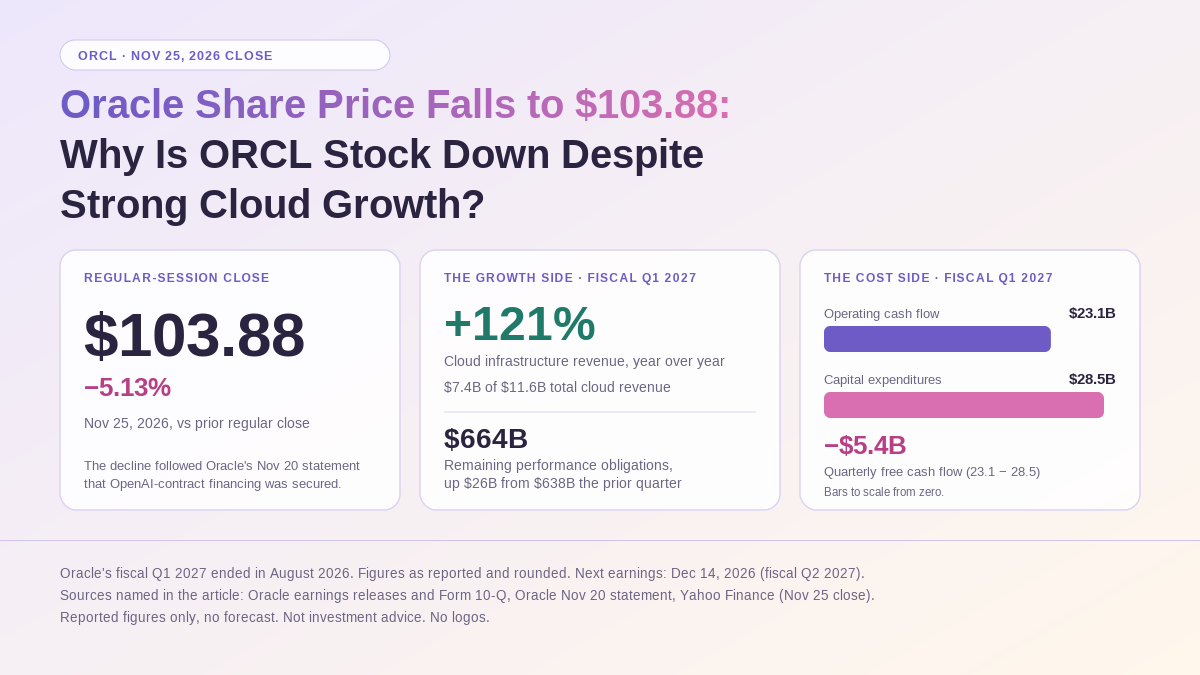
Oracle Share Price Falls to $103.88: Why Is ORCL Stock Down Despite Strong Cloud Growth?
Oracle shares fell 5.13% to $103.88. See what its $664 billion backlog, OpenAI financing, and negative free cash flow mean ahead of December earnings.

Options Market | Nvidia Sees $4.27 Million in Call Premiums from Four-Legged Sell Orders; SanDisk Continues to Decline with Investors Selling Year-End Puts for $2.7 Million

Wall Street Shifts Defensive Strategy to Fintech! Wedbush Covers 15 Stocks, Favoring Visa, Mastercard, and Robinhood

SpaceX Stock Drops Due to Rising Debt Insurance Costs

If the Fed Raises Interest Rates Multiple Times in the Coming Months, Here's What Billionaire Investor David Tepper Would Do

The Tech Sell-Off Is Creating the Best Buying Window in 2 Years. Here's What I'm Buying.
Why the Big Short Seller is Buying Tencent Against the Trend?
A New Path for API3: Fixed Supply, On-Chain Curation, and Infrastructure for AI Agents

Where Will SpaceX Stock Be in 5 Years?

Kaiko reports 12 billion USD stablecoin net redemptions in 30 days

Warren Buffett's Successor, Greg Abel, Has Quietly Purchased 3 Stocks Since the Start of the Fourth Quarter, Including Shares of a Legal Monopoly

Not Tesla. Not Nvidia. This "Magnificent Seven" Stock Could Be Overdue for a Big Rally.

UK Pension Reform Releases £11 Billion Surplus from Fixed Income Plans

Bitcoin, US Stocks, and Gold: Which Will Bottom First?

Controllable Freezing, Unregulated Refunds: The On-Chain Power and Rule Vacuums of Stablecoin Duopoly

Bank of America Warns of Underestimated 'Hard Landing' Risk in 2027! Recommends 'GRAB' to Hedge Against Volatility, Consider Chips After Dollar Peaks
The Next Stablecoin: A Potential Market of Nearly $300 Billion with 50 Times Growth Opportunity

Republican Senator Criticizes Trump for Pressuring Nvidia Board
Return to Trading Ends, Facing 100% Rate Hike Next?

South Korea's AI Chip Exports Boost Expectations for Won Appreciation

Oklo Stock Faces Cash Flow Challenges, Valuation Drops to Below 4 Billion

U.S. Justice Department Charges Over 800 in Largest Fraud Crackdown, Freezes Over $1 Billion in Assets

Intel stock falls 8.1% amid investor retreat

Workday Q3 Earnings Exceed Expectations, Q4 Subscription Revenue Guidance Below Expectations

Nutanix Q1 Earnings Per Share at $0.73, Full-Year Revenue Guidance Below Expectations

Dell Just Reported Earnings and Raised Its Forecast by $10 Billion. Is the Stock a Buy After Tuesday's Selloff?

Strategy's Business Value Falls Below Its BTC and Bitmine Approaches 5% of ETH: What Remains of the Model...
South Korean Investors Sell 10 Trillion Won in Financial Assets to Enter Real Estate Market
Is DeFi Insurance Beyond Rescue?
Who is Pricing Stripe at $200 Billion?
Oracle Share Price Falls to $103.88: Why Is ORCL Stock Down Despite Strong Cloud Growth?
Oracle shares fell 5.13% to $103.88. See what its $664 billion backlog, OpenAI financing, and negative free cash flow mean ahead of December earnings.
Options Market | Nvidia Sees $4.27 Million in Call Premiums from Four-Legged Sell Orders; SanDisk Continues to Decline with Investors Selling Year-End Puts for $2.7 Million
Wall Street Shifts Defensive Strategy to Fintech! Wedbush Covers 15 Stocks, Favoring Visa, Mastercard, and Robinhood
Latest articles


Latest coin listings on WEEX



