As Kishi Sanae Seeks Financial Support, Japan's Central Bank ETF Gains Surge

 Prefer us on Google


The value of exchange-traded funds (ETFs) held by the Bank of Japan has surpassed 100 trillion yen (approximately $628 billion) for the first time, highlighting the scale of its massive asset portfolio. Prime Minister Kishi Sanae hopes to leverage the income generated from these assets to fund her policy agenda.
According to the financial statements for the first half of fiscal 2026 released by the Bank of Japan on Thursday, the value of ETFs held by the central bank reached 113.1 trillion yen (approximately $710 billion) as of the end of September. Unrealized gains increased by 33% compared to six months ago, reaching 76 trillion yen, which is more than half of Japan's initial national budget for the current fiscal year.
These figures underscore the potential fiscal value of the Bank of Japan's substantial stock fund holdings. Last month, the central bank decided to accelerate the pace of ETF sales. As investors closely monitor how Kishi's government will raise funds for its large-scale spending plans, Kishi Sanae expressed her intention to use the proceeds from ETF sales to support the national security policy agenda.
Every March, after the end of each fiscal year, the Bank of Japan calculates its annual net income and determines the amount to be remitted to the Japanese treasury. The proceeds from ETF sales will also be included in this calculation. Last year, the Bank of Japan remitted 1.8 trillion yen to the government.
According to the Bank of Japan, in the six months ending in September, income related to ETFs—primarily from asset sales and dividends—has reached 2 trillion yen.
The policy committee led by Governor Kazuo Ueda decided at the monetary policy meeting in October to increase the pace of ETF sales to more than double the previous rate. The Bank of Japan will sell approximately 860 billion yen worth of ETFs annually at book value, up from the previous 330 billion yen.
This move comes as Japanese lawmakers are intensely debating how to fund Kishi Sanae's policy initiatives, which include lowering the food consumption tax, increasing defense spending, and launching a large-scale, multi-year economic growth promotion plan. The Japanese government typically prepares the budget for the next fiscal year in December each year.
Former policy committee member Makoto Sakurai and others believe that accelerating ETF sales may be aimed at alleviating the government's financing pressure. This reality may, in turn, reduce political resistance to further interest rate hikes by the Bank of Japan. Many economists expect the central bank to raise interest rates about two more times during the current tightening cycle.
Last week, when asked whether the decision to accelerate ETF sales was intended to assist the government, Ueda stated that the Bank of Japan made this decision independently.
The Bank of Japan estimates that at the new sales pace, it would take approximately 43 years to liquidate all ETF holdings, while at the previous pace, it would take about 110 years.
-- Price
This content is provided for general informational purposes only and doesn't constitute financial, investment, legal, or tax advice. Any events, rewards, online promotions, or related information mentioned herein should not be considered a recommendation, solicitation, or invitation to purchase, sell, trade, or otherwise deal in any crypto assets. Crypto assets are highly volatile and may result in loss. The availability of WEEX services, products, and related events may vary by region. You are responsible for ensuring that your participation is in accordance with applicable local laws and regulations.
You may also like

South Korea plans 20% cap on crypto exchange stakes, public fund likely buyer

US Treasury's FinCEN Confirms Cyberattack, Reports of Suspicious Transactions Continue Online Following CIA and ODNI Breach

The crypto market lost nearly $1 trillion in 2026

Who is Pricing Stripe at $200 Billion?

New Fed Communications: Don't Expect the Fed to Step In to Save the Market, Warsh is More Likely to Use AI's Plunge to Cool Inflation!

Investment Tycoon Ron Baron: Musk's Data Center Can Recoup Investment in Just Eight Months

Black Friday Approaches: Online Spending Exceeds Expectations as Consumers Stock Up on Essentials and Use AI Tools for Price Comparison

Marvell Falls 60% from Highs, Wall Street Analysts Slash Price Targets

Strong Demand for U.S. Infrastructure Drives Hill & Smith to Raise 2026 Profit Forecast

Building a Market Making System from Scratch: A Dropout's Four-Year Review of Crypto Trading

AI Tech Stocks Plunge While Software Stocks Remain Unscathed
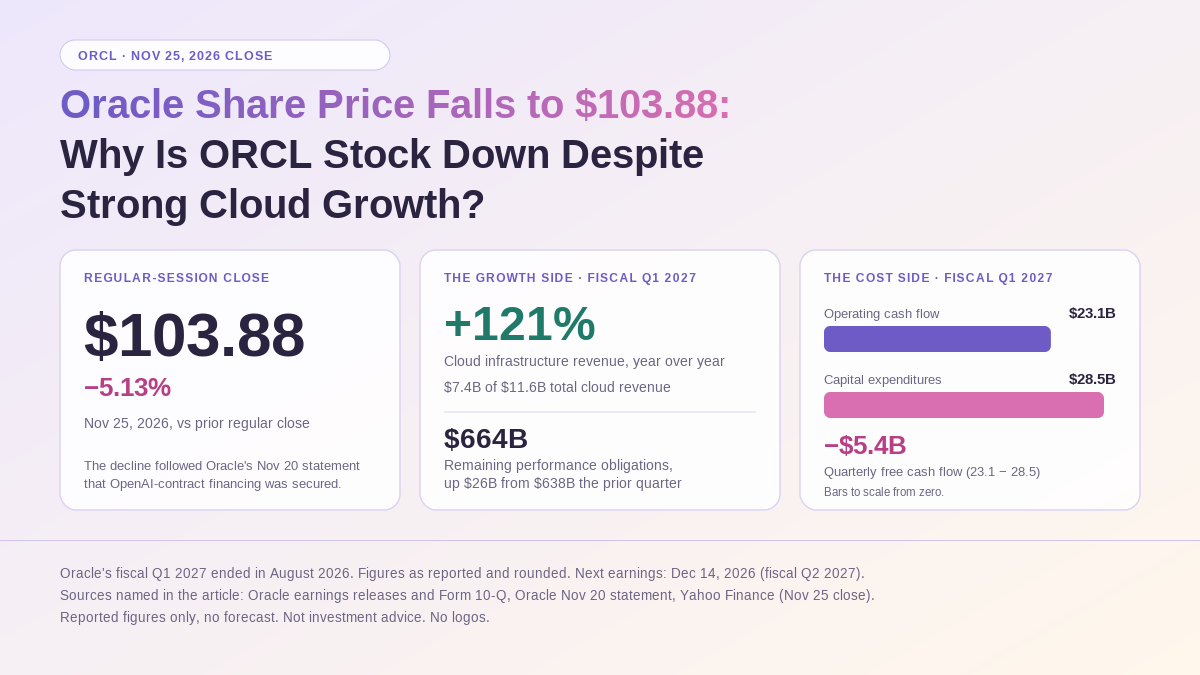
Oracle Share Price Falls to $103.88: Why Is ORCL Stock Down Despite Strong Cloud Growth?
Oracle shares fell 5.13% to $103.88. See what its $664 billion backlog, OpenAI financing, and negative free cash flow mean ahead of December earnings.

AI could threaten Bitcoin’s cryptography before quantum computers do

Singapore Opposes U.S. Excess Capacity Determination, Calls for Reconsideration of 20% Tariff

Will the Federal Reserve Raise Rates by 50 Basis Points? The Short End Has Already 'Submitted Its Paper'

Options Market | Nvidia Sees $4.27 Million in Call Premiums from Four-Legged Sell Orders; SanDisk Continues to Decline with Investors Selling Year-End Puts for $2.7 Million

Pump.fun to introduce Block0 fees to curb memecoin sniping from Dec. 4

US Banks Race Against Time to Patch Vulnerabilities Amid AI Threats

ECB Expands Collateral for Tokenized Securities, Effective June 2027

After the Proof of the Riemann Hypothesis

U.S. senators urge SEC to withdraw proposed crypto rules

Coca-Cola Has Raised Its Dividend 64 Straight Years. Here's What $10,000 Will Pay You in 2027.

3 Glorious AI Stocks to Buy Hand Over Fist If the Stock Market Crashes

Not Jensen Huang. Not Data Centers. This Is the Real Reason Nvidia Could Soar in 2027.
If the Fed Raises Interest Rates Multiple Times in the Coming Months, Here's What Billionaire Investor David Tepper Would Do

The Largest IPO in Stock Market History Is Here. What It Means for Your Portfolio
Nvidia’s Jensen Huang Should Do This 1 Thing Now

Saylor says Strategy plans to buy all Bitcoin left to be mined

The Next Big Healthcare Revolution Is Already Here. This Stock Could Cash In.

France: No mandatory declaration of crypto wallets exceeding €100,000
South Korea plans 20% cap on crypto exchange stakes, public fund likely buyer
US Treasury's FinCEN Confirms Cyberattack, Reports of Suspicious Transactions Continue Online Following CIA and ODNI Breach
The crypto market lost nearly $1 trillion in 2026
Who is Pricing Stripe at $200 Billion?
New Fed Communications: Don't Expect the Fed to Step In to Save the Market, Warsh is More Likely to Use AI's Plunge to Cool Inflation!
Investment Tycoon Ron Baron: Musk's Data Center Can Recoup Investment in Just Eight Months
Latest articles



Latest coin listings on WEEX



