
Arbitrum enables direct private stablecoin deposits through Hinkal

 Prefer us on Google
Arbitrum has introduced support for direct stablecoin deposits into private wallets through blockchain privacy protocol Hinkal, allowing users to purchase cryptocurrencies without first receiving them in a conventional public wallet.
Summary
- Arbitrum has introduced support for direct private stablecoin deposits through Hinkal, with USDC, USDT and USDG among the supported assets.
- Users can purchase stablecoins through existing fiat payment providers and receive funds directly into their confidential balances without using an intermediate public wallet.
- Hinkal uses zero knowledge proofs to conceal transaction details while allowing account holders to retain custody of their assets.
- The protocol incorporates Chainalysis screening for incoming deposits and provides viewing keys for authorized access to confidential transaction records.
According to a Nov. 25 announcement from Hinkal, users can now enter their Hinkal deposit address as the destination when purchasing stablecoins through third-party fiat on-ramp services and complete the purchase using a bank card or other supported payment methods.
The service supports several stablecoins, including USDG, Circle's USDC and Tether's USDT, with purchased assets credited to the recipient's confidential balance.
Arbitrum confirmed the integration in a separate announcement on X, where the Ethereum layer 2 network said:
"Privacy will be at the forefront in the programmable economy."
How do private deposits work on Arbitrum?
As explained in Hinkal's deposit address documentation, the protocol generates a receiving address connected to the user's confidential account that functions like an ordinary cryptocurrency address from the sender's perspective.
Incoming payments are automatically shielded once they pass the protocol's screening requirements, eliminating the need for recipients to submit a separate transaction to move the assets into their private balance.
The deposit mechanism can be used for withdrawals from centralized exchanges, business settlements and payments from external wallets, provided the sender uses a supported blockchain and cryptocurrency. Senders do not need to register with Hinkal or install its software to complete a payment.
Hinkal's wallet infrastructure dates back to November 2025, when the Stanford-incubated company launched its Invisible Wallet, a browser extension designed to conceal transaction histories while allowing users to interact with decentralized finance applications.
At launch, the wallet supported Ethereum, Arbitrum, Polygon, Base and Optimism.
Hinkal uses zero-knowledge proofs to conceal transactions
At the technical level, Hinkal uses zero-knowledge cryptography to verify transactions without publicly revealing the financial information used to authorize them.
Individuals can access confidential balances using their existing cryptocurrency wallets, with control over the underlying assets remaining with the account holder. Transactions between confidential accounts conceal information such as the sender, recipient and amount transferred.
Payments can be made to conventional blockchain addresses from within a confidential account, although the recipient and payout amount become publicly visible when the assets reach the destination.
As crypto.news reported in May, Polygon introduced private stablecoin transfers through an integration with Hinkal that allows businesses and individuals to route payments through a shielded pool while retaining access to records required for regulatory and tax reporting.
Arbitrum has attracted other privacy infrastructure providers this year, including AmericanFortress, which launched its institutional privacy layer in May.
The company's system uses automatically generated stealth addresses and human-readable payment identifiers to conceal relationships between transaction counterparties while keeping records accessible to the parties involved.
How Hinkal screens private stablecoin payments
Despite concealing transaction activity, Hinkal incorporates wallet screening through blockchain analytics provider Chainalysis to prevent funds associated with sanctioned or high-risk addresses from entering confidential accounts.
According to the protocol's compliance framework, every deposit receives a unique identifier associated with its originating wallet address.
Depositor addresses are monitored against updated risk and sanctions databases even after the assets have entered the protocol. If an address is subsequently flagged, the associated funds lose access to confidential transfers and can only be withdrawn publicly to the original depositing address.
Hinkal does not conduct identity-based Know Your Customer checks itself, leaving customer verification and other applicable regulatory obligations with the businesses and payment providers using its infrastructure.
Account holders can grant regulators, auditors or counterparties access to financial records through read-only viewing keys, which do not confer permission to transfer or spend assets.
Organizations can maintain a master viewing key that provides authorized personnel with access to confidential transaction records across individual team accounts, while users retain separate keys for authorizing payments.
Hinkal's security documentation lists several firms that have reviewed its smart contracts and cryptographic circuits, including Quantstamp, Hexens and zkSecurity. The protocol maintains a bug bounty program through HackenProof that offers rewards of up to $10,000 for critical vulnerabilities.
This content is provided for general informational purposes only and doesn't constitute financial, investment, legal, or tax advice. Any events, rewards, online promotions, or related information mentioned herein should not be considered a recommendation, solicitation, or invitation to purchase, sell, trade, or otherwise deal in any crypto assets. Crypto assets are highly volatile and may result in loss. The availability of WEEX services, products, and related events may vary by region. You are responsible for ensuring that your participation is in accordance with applicable local laws and regulations.
You may also like

Houthi Drone Attack on Saudi Arabia's Largest Oil Refinery Sends Brent Crude Back to $92
Franklin Templeton to add Hyperliquid to its crypto index ETF in December

Saylor says Strategy plans to buy all Bitcoin left to be mined

The Next Big Healthcare Revolution Is Already Here. This Stock Could Cash In.

France: No mandatory declaration of crypto wallets exceeding €100,000

Banks Control Korean Won Stablecoin, Tech Companies Compete for Customers

15,400 people lost over $13 million after copying the wallet of a crypto specialist
The Tech Sell-Off Is Creating the Best Buying Window in 2 Years. Here's What I'm Buying.

Why the Big Short Seller is Buying Tencent Against the Trend?

From Securing Private Keys to Constraining Agents: New Frontiers of Crypto Security in the AI Era
The AI Power Surge Returns to Rationality: Where to Find Valuation Lows

Prediction: Micron Stock Will Be at This Price at the End of 2027

How to Use Tokenized Stocks on the Blockchain?
Bitcoin ETF Surpasses 2,200 Institutional Holders, Primarily Investment Advisors

First Circle Capital Announces Final Closing of $26 Million Fund to Invest in Fintech in Africa
A New Path for API3: Fixed Supply, On-Chain Curation, and Infrastructure for AI Agents

Nestlé Expands into Wearable Devices, Plans to Match Nutritional Products with Health Data

ECB Governing Council Member Kocher Warns Against Lagging in Inflation Response

Over 20% of Generation Z Own Cryptocurrency, Barriers to Adoption for the General Public Include 'Fragmentation of Financial Services' = SoFi Survey

Where Will SpaceX Stock Be in 5 Years?

Ray Dalio's Latest Interview: Why Great Technologies Are Often Not Great Investments?

Will On-Chain BTC Lending Become Mainstream? Data and Institutional Trends Point to Traditional Finance

Is BTC Different This Time?
Tonight, the last major inflation report before the Federal Reserve's December decision is released!
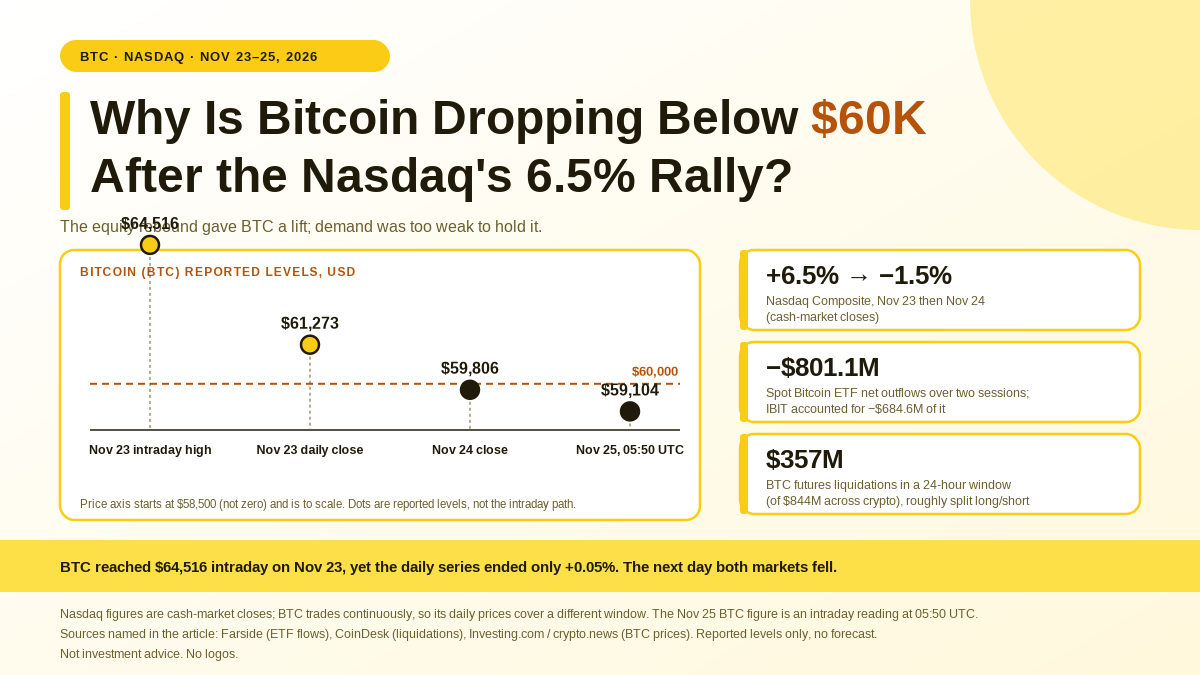
Why Is Bitcoin Dropping Below $60K After the Nasdaq’s 6.5% Rally?
Why is Bitcoin dropping below $60,000 after the Nasdaq rallied 6.5%? See what $801.1 million in ETF outflows, exchange flows, and liquidations reveal.

Report: AI Industry Leaders Divided Over Whether Humans Should Surrender Autonomous Decision-Making Power

Remy Cointreau Group's Stock Price Soars Amid Transformation Progress

Warren Buffett's Successor, Greg Abel, Has Quietly Purchased 3 Stocks Since the Start of the Fourth Quarter, Including Shares of a Legal Monopoly

Not Tesla. Not Nvidia. This "Magnificent Seven" Stock Could Be Overdue for a Big Rally.
Iliad Partners Announces Final Close of Its First Fund at $33.4 Million
Houthi Drone Attack on Saudi Arabia's Largest Oil Refinery Sends Brent Crude Back to $92
Franklin Templeton to add Hyperliquid to its crypto index ETF in December
Saylor says Strategy plans to buy all Bitcoin left to be mined
The Next Big Healthcare Revolution Is Already Here. This Stock Could Cash In.
France: No mandatory declaration of crypto wallets exceeding €100,000
Banks Control Korean Won Stablecoin, Tech Companies Compete for Customers
Latest articles
Latest coin listings on WEEX


