Standard Chartered-backed Zodia Custody hit by client data breach

 Prefer us on Google


Institutional cryptocurrency custodian Zodia Custody has suffered a security breach that exposed personal information belonging to some of its clients and employees.
Summary
- Zodia Custody detected a security breach on Nov. 23 that exposed personal information belonging to some of its clients and employees.
- CEO Richard Clark confirmed that the compromised information included names and email addresses in an emailed statement to Reuters.
- The incident follows Standard Chartered's Oct. 21 announcement of definitive agreements to acquire full ownership of the institutional crypto custodian.
- Shares of Standard Chartered were trading 2.6% higher in London on Thursday.
In an emailed statement to Reuters on Thursday, Nov. 26, Zodia Custody CEO Richard Clark confirmed that the company had detected the breach on Monday, Nov. 23, and that the information exposed included names and email addresses.
Shares of Standard Chartered, which has been working to bring Zodia Custody's operations into its international banking business, were trading 2.6% higher in London on Thursday.
Founded in 2020 through a partnership between Standard Chartered and Northern Trust, Zodia Custody caters primarily to institutional investors, including financial institutions, asset managers, and hedge funds. The business has since attracted investment from several major banks, including Japan's SBI Holdings, National Australia Bank, and Emirates NBD.
How Zodia Custody handles institutional assets
Zodia Custody operates a segregated custody model, under which digital assets belonging to individual clients are held in separate wallets according to their instructions.
According to the company's custody policy, its core storage infrastructure keeps cryptographic keys offline, with transactions requiring multiple independent approvals and authentication checks before assets can be withdrawn.
Alongside its cold storage infrastructure, the custodian offers a separate solution based on multi-party computation, where the cryptographic information required to authorize transactions is distributed across multiple secure environments instead of being held in one location.
Earlier this month, Clark told crypto.news that financial institutions using tokenized assets as collateral need infrastructure that allows them to move assets continuously while retaining the protections associated with institutional custody.
Standard Chartered moves to consolidate its crypto custody business
The security incident follows Standard Chartered's Oct. 21 announcement that it had entered into definitive agreements to acquire the entirety of Zodia Custody through its subsidiary, Standard Chartered I H Limited.
The bank first secured the acceptance of its nonbinding acquisition offer from Zodia's shareholders and noteholders in May, with the parties initially expecting to finalize their agreements by the end of June and complete the transaction before the end of August.
As part of the revised acquisition arrangement, Zodia's regulated operations across Singapore, Hong Kong, Australia, the United Arab Emirates, and Luxembourg are to become part of Standard Chartered's Securities Services division, which already provides custody for traditional financial instruments and digital assets.
Meanwhile, the custodian's software development and professional services operations are being separated into an independent company called Zodia Solutions under SC Ventures, Standard Chartered's investment and innovation arm.
Led by Craig Perrin, the new business will supply digital asset infrastructure to financial institutions, including Standard Chartered itself, and will retain the backing of several existing Zodia investors.
Zodia has expanded its regulated custody operations
Over the past year, Zodia Custody has secured several regulatory permissions that allow it to handle financial instruments beyond conventional cryptocurrencies.
In June, its European subsidiary obtained a payment institution license from Luxembourg's Commission de Surveillance du Secteur Financier, allowing it to offer regulated transfer services for electronic money tokens alongside its existing crypto asset safekeeping business.
The authorization complements the company's Markets in Crypto-Assets license, which it received in December 2025 and which allows it to provide regulated cryptocurrency custody services across European Union member states.
On Oct. 12, Zodia announced that Abu Dhabi Global Market's Financial Services Regulatory Authority had expanded the license held by its regional subsidiary, Tungsten Custody Solutions Limited, to cover the custody of digital securities.
The subsidiary intends to initially focus on tokenized money market instruments before expanding its services to support other traditional financial assets represented on blockchain networks.
-- Price
This content is provided for general informational purposes only and doesn't constitute financial, investment, legal, or tax advice. Any events, rewards, online promotions, or related information mentioned herein should not be considered a recommendation, solicitation, or invitation to purchase, sell, trade, or otherwise deal in any crypto assets. Crypto assets are highly volatile and may result in loss. The availability of WEEX services, products, and related events may vary by region. You are responsible for ensuring that your participation is in accordance with applicable local laws and regulations.
You may also like

Gold: Despite the price collapse, ETFs added $2.7 billion in October

AI Data Theft and Model Replacement: Why Privacy Token VVV is Surging Against the Trend?
Samsung C&T moves $180M through Citi’s blockchain-based deposit token service in six months

Irish Officials Attend Launch of Licensed Platform After MiCA Implementation
European Wealthy Investors Turn to Alternative Assets Amid AI Sell-off

AI Tech Stocks Plunge While Software Stocks Remain Unscathed
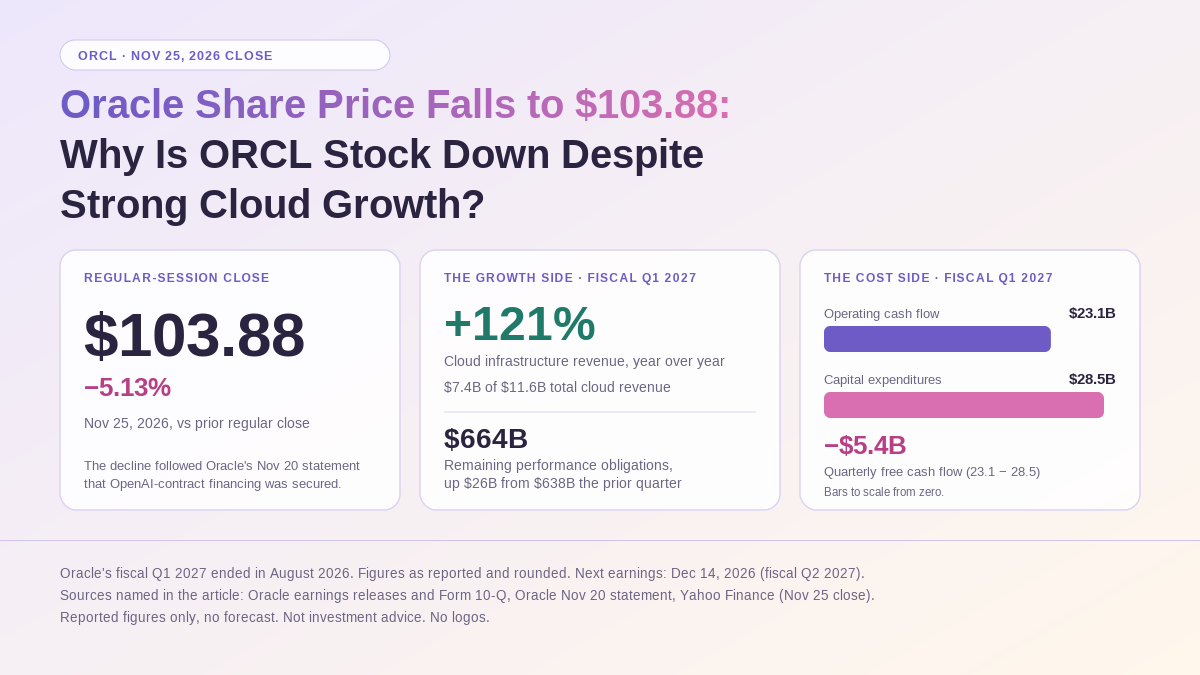
Oracle Share Price Falls to $103.88: Why Is ORCL Stock Down Despite Strong Cloud Growth?
Oracle shares fell 5.13% to $103.88. See what its $664 billion backlog, OpenAI financing, and negative free cash flow mean ahead of December earnings.

Xiong'an Satellite AIT Center Officially Commences Operations

Overseas GPU Rentals Become Increasingly Difficult: China's Large Models Embark on the Domestic Computing Power 'Long March'

Will the Federal Reserve Raise Rates by 50 Basis Points? The Short End Has Already 'Submitted Its Paper'

Supply of Bridge Tokens: What Happens When Two Chains Are Added Together?

WTI Futures Roll and XTIUSDT: Reasons for Divergent Movements in Oil Charts

Sam Price Analyzes the Dollar Index and Precious Metal Trends

RISC Zero Fixes Proof Forgery Vulnerability, Requires Users to Upgrade to 3.1.0

Compass Delays $380 Million ABS Issuance Due to Data Center Cooling Failure and Investor Withdrawals

ANZ Bank Removed from New York Fed's Forex Counterparty List
S&P Considers Downgrading Nvidia's Credit Rating Amid Governance Concerns

Baidu Releases ERNIE 5.5 Flash Preview AI Model for Free

CEO of Ontario Teachers' Pension Plan: Lengthy AI Infrastructure Build-Out Poses Investment Risks

U.S. senators urge SEC to withdraw proposed crypto rules

Abercrombie & Fitch Grew Sales for the 16th Straight Quarter as Earnings Jumped 62%. Here's What's Behind the Streak.

U.S. Treasury Yields Hit Two-Month Low as Market Risk Aversion Intensifies

Amazon Is Backing More Than 5 Gigawatts of New Nuclear by 2039. This Reactor Developer Could Cash In.

Not Jensen Huang. Not Data Centers. This Is the Real Reason Nvidia Could Soar in 2027.
AI Bonds Have Dropped to Cheap Enough Levels: DoubleLine's Cohen Shifts from Bearish to Buy
Nvidia’s Jensen Huang Should Do This 1 Thing Now

Houthi Drone Attack on Saudi Arabia's Largest Oil Refinery Sends Brent Crude Back to $92

Bitcoin Researchers Discover Suspected Fake Electrum Servers Intercepting Wallet Data
France: No mandatory declaration of crypto wallets exceeding €100,000
Polymarket's New Matching Engine Nex Accelerates Order Speed by 10 Times, Launch Date to be Announced Next Week
Gold: Despite the price collapse, ETFs added $2.7 billion in October
AI Data Theft and Model Replacement: Why Privacy Token VVV is Surging Against the Trend?
Samsung C&T moves $180M through Citi’s blockchain-based deposit token service in six months
Irish Officials Attend Launch of Licensed Platform After MiCA Implementation
European Wealthy Investors Turn to Alternative Assets Amid AI Sell-off
AI Tech Stocks Plunge While Software Stocks Remain Unscathed
Latest articles


Latest coin listings on WEEX



