
Samsung Wallet could support Korean won stablecoins, executive says

 Prefer us on Google


A Samsung Global Research executive has suggested that a Korean won-denominated stablecoin could eventually be integrated into Samsung Wallet as South Korea prepares to introduce new rules for digital assets.
Summary
- Samsung Global Research executive Park Hyun-soo said a Korean won stablecoin could be integrated into Samsung Wallet if such a digital currency is introduced.
- Park pointed to Samsung Wallet's existing US stablecoin service, which supports international transfers to more than 60 countries, as a possible model for South Korea.
- The executive said stablecoins could be used to settle tokenized securities transactions as South Korea prepares for full scale STO issuance next year.
- Park warned that widespread stablecoin adoption could affect bank lending, monetary policy and market competition, while regulatory compliance could raise transaction costs.
Park Hyun-soo, managing director at Samsung Global Research, made the remarks on November 5 during a policy seminar at the National Assembly Members' Office Building in Seoul's Yeouido district, held to mark the publication of The Future of Money, the Stablecoin Revolution.
According to Park, Samsung's existing stablecoin services in the United States could provide a model for introducing similar payment features in South Korea if won-backed stablecoins are issued under the country's developing regulatory framework.
"In the U.S., users can hold dollar-based stablecoins in Samsung Wallet, and the service recently began offering transfers to 60 countries," Park said.
He explained that a similar arrangement could be introduced in South Korea if a won-denominated stablecoin becomes available, allowing users to access the digital currency through Samsung Wallet.
Park suggested that bringing stablecoins into the country's regulated financial system could create opportunities for domestic digital payment services beyond conventional bank transfers and card payments.
His comments come roughly a month after Samsung announced its first major stablecoin integration in the United States, where USDC support was introduced through partnerships with Coinbase and digital asset infrastructure provider Bastion.
Samsung Wallet's US stablecoin service offers a possible model
As previously reported by crypto.news, Samsung announced in October that its wallet application would support USDC transfers across 82 million compatible Galaxy devices in the United States.
The service began rolling out in the final week of October, allowing eligible users to hold USDC, transfer the stablecoin to compatible cryptocurrency wallets and send money to qualifying bank accounts overseas.
Under the arrangement, Samsung Wallet supports international remittances to more than 60 countries, with recipients able to receive funds in their local currencies without opening a cryptocurrency wallet.
Samsung's official announcement identified Bastion as the infrastructure provider responsible for the service, while Coinbase Prime Vault handles custody of the underlying USDC through Bastion.
Solana and Sui provide blockchain infrastructure support, while eligible transfers require identity verification and biometric authentication on registered Samsung devices.
The company has said that future services could include stablecoin payments at online stores and physical retail locations, with expansion into additional markets depending on local regulations.
Park's proposal for South Korea would depend on the issuance of a won-backed stablecoin and the regulatory conditions governing its use in domestic payment applications.
Korean financial firms explore stablecoins for securities settlement
Beyond consumer payments, Park identified tokenized securities as another area where stablecoins could become useful once South Korea's planned regulatory framework takes effect.
He said financial institutions are preparing for the introduction of security token offerings, or STOs, with full-scale issuance expected to begin next year.
According to the executive, using stablecoins to settle securities transactions on blockchain networks could provide a more efficient payment process as tokenized financial products become available.
South Korea is already preparing for such a system.
The country's Financial Services Commission has proposed detailed rules that would allow stocks, bonds, investment funds and certain fractional investment products to enter its regulated tokenized securities market from February 4, 2027.
The proposed framework includes requirements for issuers, distributed ledger operations and licensed over-the-counter trading platforms. Public consultation on the rules is scheduled to continue until November 11.
Financial institutions have begun testing how stablecoins could fit into the settlement process.
In September, Eugene Investment & Securities partnered with BEATOZ to examine whether stablecoins could be used for subscription payments involving tokenized securities.
The project is designed to test whether subscriptions, payments and settlement can be handled within a single blockchain-based system, instead of relying on separate conventional banking arrangements.
Park said card companies and insurers are reviewing potential stablecoin applications within their own payment systems, although he did not identify individual companies or announce specific services.
Samsung executive warns of risks to banks and monetary policy
Despite the potential applications, Park cautioned that widespread stablecoin adoption could create challenges for South Korea's existing financial system.
One concern involves commercial bank deposits, which provide an important source of funding for lending activities.
If customers move substantial amounts of money from bank deposits into stablecoins, Park warned that banks could face constraints on their ability to create credit.
He said such a development could affect financing for small and medium-sized businesses and borrowers with weaker credit profiles, which depend heavily on traditional banking services.
Monetary policy presents another challenge. According to Park, stablecoins that do not pay interest could weaken the transmission of central bank interest rate decisions through the financial system.
He raised concerns about competition, warning that network effects could concentrate stablecoin activity among a small number of issuers or give major technology companies considerable influence over digital payments.
Regulatory compliance could affect the economics of stablecoin transactions as well.
Although stablecoins are often associated with low transaction costs, Park said expenses could rise once anti-money laundering requirements and know-your-customer checks are applied across the sector.
South Korean financial companies have already begun examining those requirements as part of their stablecoin development plans.
In September, Kakao Pay and KakaoBank signed an agreement with Fireblocks to test digital asset infrastructure, including stablecoin distribution systems designed around domestic regulatory and security requirements.
The planned trials cover technical feasibility and compliance, with the companies yet to announce a commercial stablecoin launch.
"That does not mean stablecoins should not be introduced," Park said. "But the framework needs to be designed with these issues fully in mind so that stablecoins can become a tool for sound financial innovation."
-- Price
This content is provided for general informational purposes only and doesn't constitute financial, investment, legal, or tax advice. Any events, rewards, online promotions, or related information mentioned herein should not be considered a recommendation, solicitation, or invitation to purchase, sell, trade, or otherwise deal in any crypto assets. Crypto assets are highly volatile and may result in loss. The availability of WEEX services, products, and related events may vary by region. You are responsible for ensuring that your participation is in accordance with applicable local laws and regulations.
You may also like

Brale lets businesses launch USD stablecoins on Cardano

Ansem and Satoshi Nakamoto: Living Under the Same 'Stolen' Roof
Cyber Loses 5.213 Million CYBER in Theft, Equivalent Tokens Destroyed
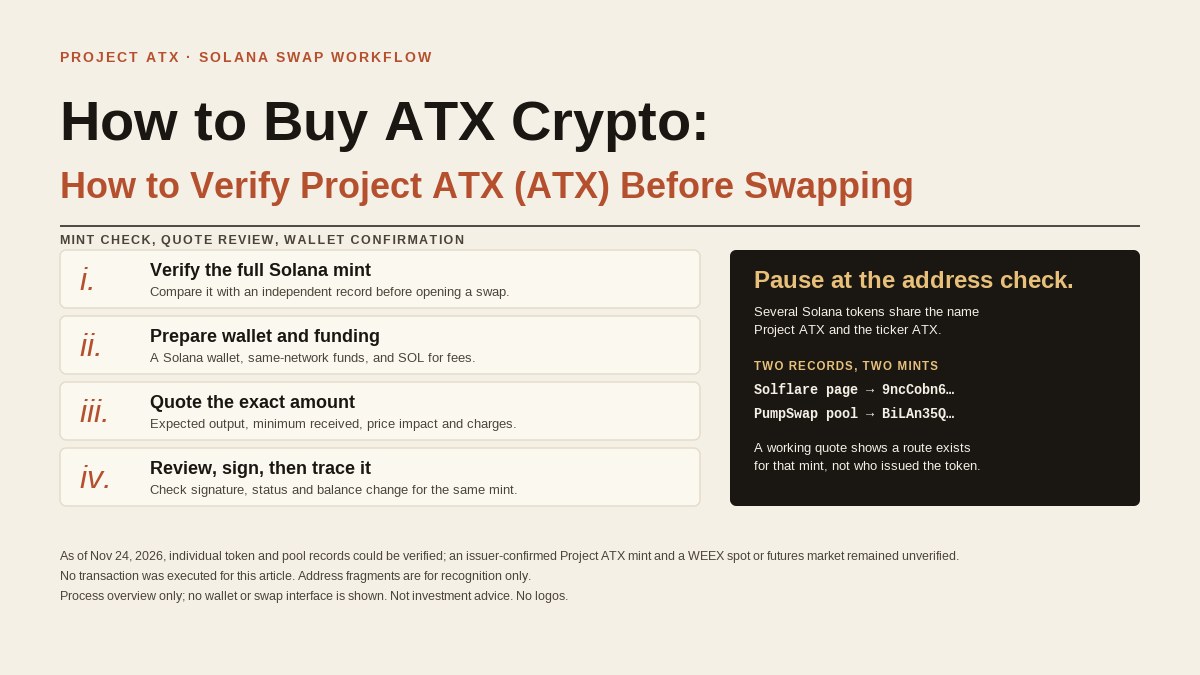
How to Buy ATX Crypto: How to Verify Project ATX (ATX) Before Swapping
Learn how to buy ATX crypto on Solana. Verify the Project ATX mint, review swap quotes and fees, and confirm the exact token you receive on-chain.

Why Is the ATX Crypto Price Different Across Platforms? Project ATX (ATX) Explained
See why the ATX crypto price varies across platforms. Compare Project ATX mint addresses, PumpSwap pools, and swap quotes for the same trade size.
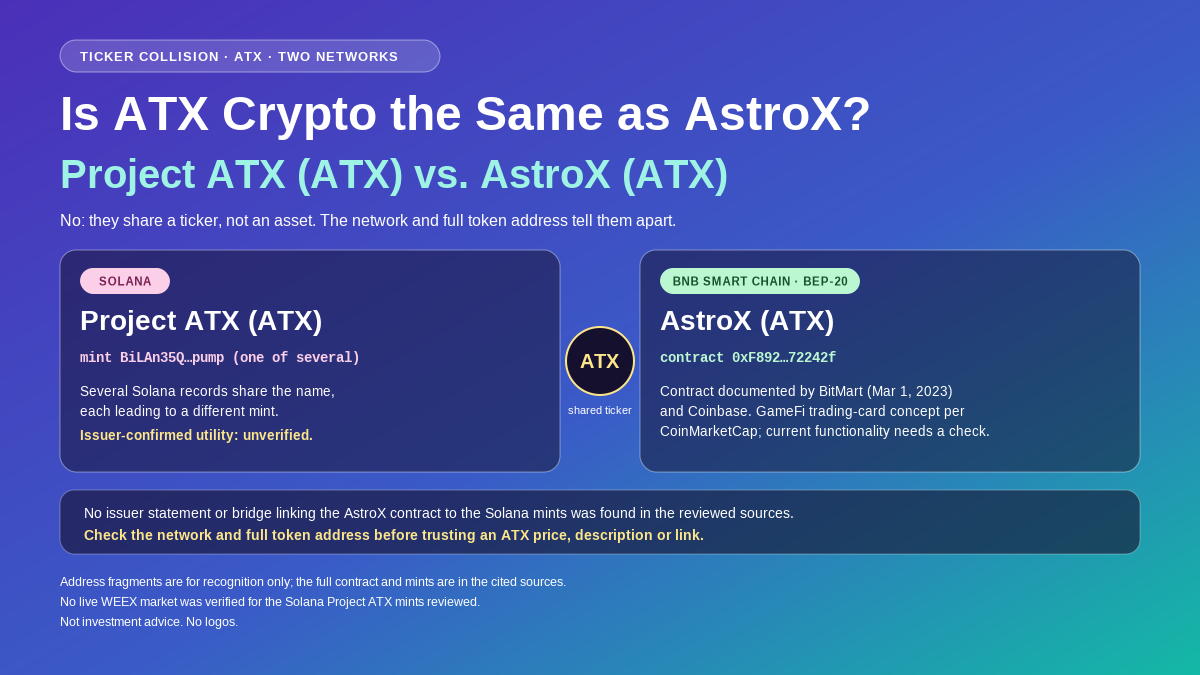
Is ATX Crypto the Same as AstroX? Project ATX (ATX) vs. AstroX (ATX)
Compare Project ATX on Solana with AstroX on BNB Smart Chain. Learn how to verify each token address before trusting an ATX price or buying guide.
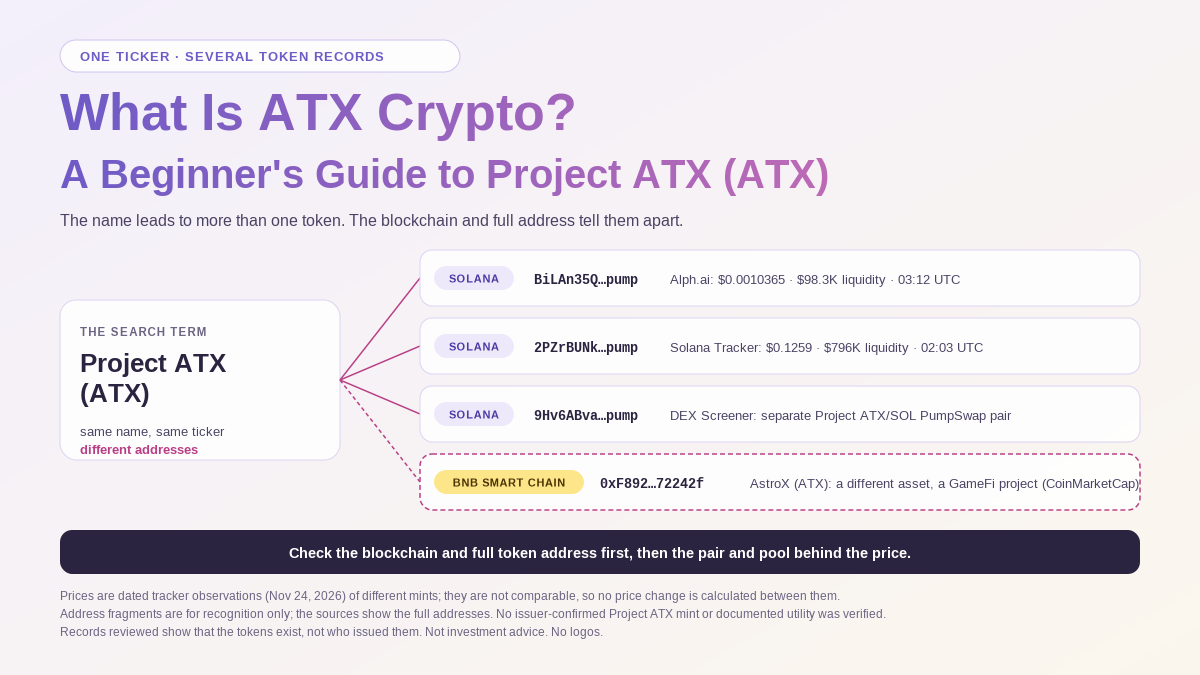
What Is ATX Crypto? A Beginner’s Guide to Project ATX (ATX)
Learn what ATX crypto means, why Project ATX appears under multiple Solana mint addresses, and how to tell those tokens apart from AstroX (ATX).

Amazon Supports Media AI Monetization with Article Access Fees in USDC

Samsung Wallet Starts Supporting Zero-Fee USDC Transfers via Sui Network

BitMine Increases Holdings by 7,819 ETH, Tom Lee States ETH's Annual Supply Growth Rate is Comparable to Bitcoin's

Trezor and Exodus Users Lose Over $600,000 on the Same iPhone

Polygon Labs launches Agglayer v1.0 with cross-chain settlement under 2 minutes

Solana Showcases AI Ecosystem Products and Development Tools

Cyber Prevents Cross-Chain Bridge Attack, Treasury Bears the Cost of Abnormal CYBER Issuance
KOSPI crash raises fears of further crypto market sell-off
Visa Crypto Labs launches new wallet that lets AI work and earn for you

Solana’s new memory checks could make some older app transactions fail
Solana upgrades to mainnet 1.0 as Foundation takes majority CoinGecko stake
IOSCO Warns of 'Quantum Delay' and Assesses Readiness for Quantum Threat
Cardano founder Hoskinson claims the network is functioning despite ADA price drop
PA Daily | US Spot Bitcoin ETF Has Seen Outflows of $3.47 Billion So Far in November; Abraxas Capital Buys $897 Million Worth of Bitcoin During Market Correction
Peter Schiff says Solana can replace Bitcoin exposure. Can it?

Cyber Faces Token Minting Issue on Solana

Solana 2027 Roadmap: Doubling Computing Power, Reducing Transaction Costs by 80%
Peter Schiff Points Out High Correlation in Mainstream Cryptocurrency Trends
Solana Heads Towards Its Worst Year in History

Follow the Money: Variational Raises $110 Million, Tether Activity and M&A Deals
Carl Moon Reveals Bitcoin Drops to $55,615

Anthropic's Largest IPO Ever Sees Stock Tokens Launch on Multiple Blockchains, Trading Volume Exceeds 1.5 Billion Yen

Hacker Transfers Approximately 488,000 ETH Worth About $860 Million
Brale lets businesses launch USD stablecoins on Cardano
Ansem and Satoshi Nakamoto: Living Under the Same 'Stolen' Roof
Cyber Loses 5.213 Million CYBER in Theft, Equivalent Tokens Destroyed
How to Buy ATX Crypto: How to Verify Project ATX (ATX) Before Swapping
Learn how to buy ATX crypto on Solana. Verify the Project ATX mint, review swap quotes and fees, and confirm the exact token you receive on-chain.
Why Is the ATX Crypto Price Different Across Platforms? Project ATX (ATX) Explained
See why the ATX crypto price varies across platforms. Compare Project ATX mint addresses, PumpSwap pools, and swap quotes for the same trade size.
Is ATX Crypto the Same as AstroX? Project ATX (ATX) vs. AstroX (ATX)
Compare Project ATX on Solana with AstroX on BNB Smart Chain. Learn how to verify each token address before trusting an ATX price or buying guide.
Latest articles





Latest coin listings on WEEX


