
Oracle Earnings: Can a $664B Backlog Outrun $20B of New Funding?

 Prefer us on Google

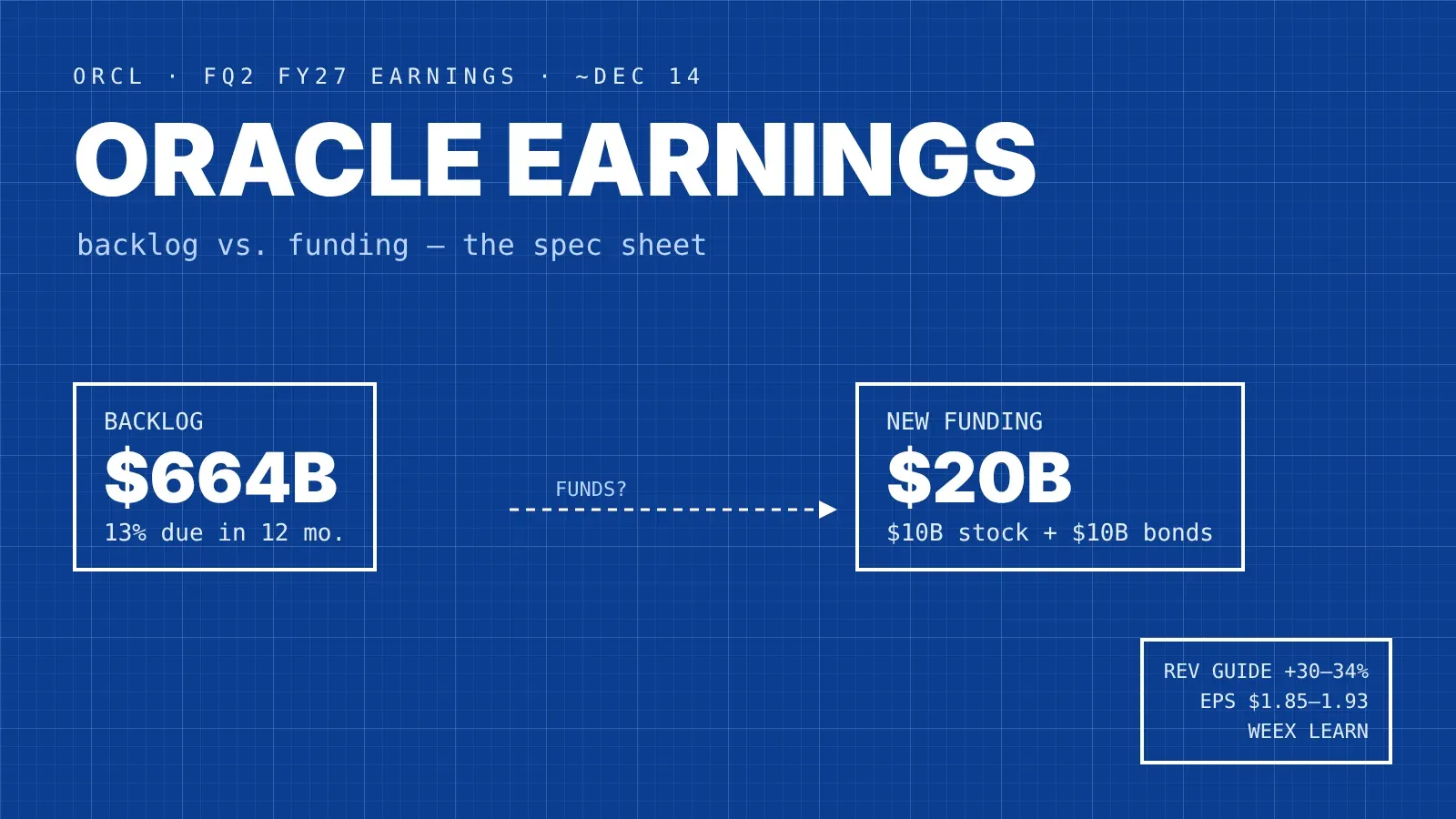
Oracle's next earnings report, for fiscal Q2 2027, is expected around December 14, 2026, and it lands at the worst possible moment for the stock: ORCL is down roughly 42% this year, and the company just sold $10 billion of new shares and $10 billion of bonds in a single week. Oracle has guided for revenue growth of 30% to 34%, and its contracted backlog has reached $664 billion. This article explains what Wall Street expects from Oracle earnings, why the funding question now matters more than the growth numbers, and the four figures to watch on the night.
Oracle Earnings Date and What Wall Street Expects
Oracle has not yet confirmed the date. Investing.com, TipRanks and MarketBeat all estimate Monday, December 14, 2026, based on its past reporting schedule. Oracle normally announces the date about a week ahead and reports after the US close.
Here is what the market is looking for, against Oracle's own guidance from September:
- Revenue: Oracle guided for growth of 30% to 34%. The analyst consensus is about $21.33 billion, up roughly 33% from $16.06 billion a year earlier.
- Non-GAAP EPS: Guidance is $1.85 to $1.93 in USD. Consensus sits at $1.89, right in the middle.
- Full fiscal 2027: Oracle expects at least $90 billion of revenue and non-GAAP EPS of $8.10.
For context, last quarter Oracle beat. Fiscal Q1 EPS came in at $1.92 against a $1.73 forecast, on revenue of $19.3 billion.
Why the Funding Question Now Matters More Than Growth
Oracle's problem is not demand. It is the cost of meeting it.
Its contracted backlog reached $664 billion, but only about 13% of that is due within a year. To build the data centers behind it, Oracle spent $28.5 billion on capex in a single quarter, more than its operating cash flow, and has filled the gap with bonds, stock and leases.
That gap came into the open in early November. Oracle sold 86,206,897 new shares in a $10 billion stock offering that closed on November 4, alongside $10 billion of notes paying 7.000% to 8.650%. In June it had said it did not expect to issue more debt in calendar 2026.
At its Investor Day, Oracle tried to put a ceiling on the problem:
- Additional capital raises through fiscal 2030 capped at $20 billion, split equally between equity and debt.
- Positive free cash flow targeted for the second half of fiscal 2028.
- A fiscal 2030 target of more than $225 billion in revenue and non-GAAP EPS above $21.
The better reading: those targets are ambitious, but the market now wants proof that spending is converting into cash, not just bigger backlog numbers.
ORCL Price on WEEX Before Earnings
On November 25 (UTC), WEEX data showed:
- ORCL stock page: 108.50 USDT while the US market was closed.
- ORCLUSDT perpetual: 106.57 USDT, down 7.22% over 24 hours, in a range of 106.50 to 114.89, on about 677,384 USDT of volume. Funding was 0.000003%, essentially flat.
The stock has slid fast. ORCL closed at $125.35 on November 13, already 49% below its June 1 high. There was one bright spot on November 23, when shares rose more than 4% in premarket trading after Oracle said it had secured all the funding for its OpenAI contract. That gain did not hold through the chip sell-off that followed.
-- Price
Four Numbers That Decide Oracle's Next Move
- Capex versus operating cash flow. If capex again exceeds cash generated, the funding worry deepens. A narrowing gap would be the single most reassuring sign.
- Remaining performance obligations (RPO). Growth is expected, but watch how much is due within 12 months. A rising near-term share means backlog is turning into revenue faster.
- Cloud infrastructure revenue growth. This is the engine behind the AI story. A slowdown here would undercut the case for all the spending.
- Any update on the $20 billion cap. If Oracle signals it may need more capital before fiscal 2030, expect a sharp reaction.
What traders usually miss with Oracle: the stock often moves on guidance and backlog commentary, not the headline beat. In December 2025, Oracle beat on EPS but missed on revenue, and spending concerns dominated the reaction. A strong quarter can still trade lower if the cash-flow picture does not improve.
If you trade the ORCLUSDT perpetual around the report, remember it gives price exposure only, with no shares, votes or dividends. Earnings nights can move a stock 10% or more in minutes, so leverage needs a stop-loss set in advance.
Oracle earnings will be judged on cash, not growth. The guidance is achievable; the question is whether Oracle can show its $664 billion backlog will pay for itself before it needs to borrow again.
FAQ
1. When is Oracle's next earnings report?
Oracle is expected to report fiscal Q2 2027 results around December 14, 2026, after the US market close. Oracle has not yet confirmed the date.
2. What are analysts expecting from Oracle earnings?
Consensus is about $21.33 billion of revenue and non-GAAP EPS of $1.89. Oracle guided for 30% to 34% revenue growth and EPS of $1.85 to $1.93.
3. Why is Oracle stock down in 2026?
ORCL is down about 42% this year as investors worry about heavy data center spending, rising debt, negative free cash flow and the $20 billion of stock and bonds Oracle sold in November.
4. What is Oracle's backlog?
Oracle's contracted backlog reached $664 billion, though only about 13% of it is due to be recognized within a year.
This content is provided for general informational purposes only and doesn't constitute financial, investment, legal, or tax advice. Any events, rewards, online promotions, or related information mentioned herein should not be considered a recommendation, solicitation, or invitation to purchase, sell, trade, or otherwise deal in any crypto assets. Crypto assets are highly volatile and may result in loss. The availability of WEEX services, products, and related events may vary by region. You are responsible for ensuring that your participation is in accordance with applicable local laws and regulations.
You may also like
View moreBuy Nvidia Stock With Crypto: 3 Ways After the 31% Huang Rally
Beginner3 minTradingMicron Earnings Dec. 17: Why MU Fell 11% Right After a 19% Jump
Beginner3 minTradingBroadcom Earnings Dec. 9: Can a $34.8B Guide Stop AVGO's Slide?
Beginner3 minTradingStrategy Stock Fell 30%: What the Nov. 30 MSCI Exit Means for MSTR
Beginner3 minTradingAMZN Stock Up 3.8%, Then Down 3.9%: Is the AWS AI News Priced In?
Beginner5 minTradingAnthropic Stock After Day One: Why ANT Tokens Trade Near $92
Beginner3 minTrading
Contents
Popular coins
Latest articles


